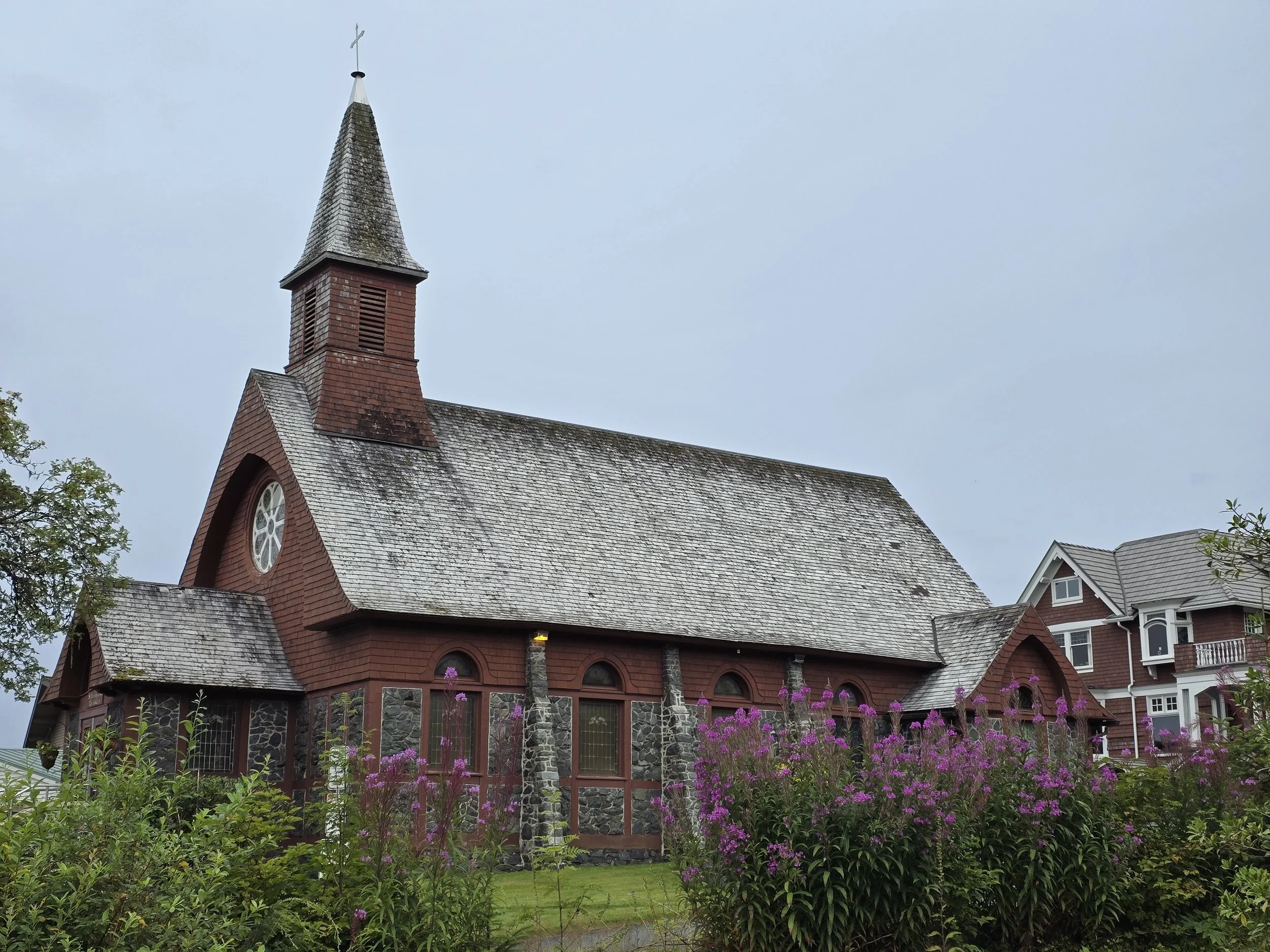
Scriptures: Isaiah 51:1-6; Psalm 138; Romans 12:1-8; Matthew 16:13-20
Sermon by The Rev. Kathryn Snelling, Deacon
Well, as we all probably know our English language can be a little quirky. Some words sound the same - through and threw for example, sound the same, but when used mean something totally different from each other. It is only in context that you understand - “ he threw the ball through the window.”
And sometimes the meaning of a word, overtime, changes through social and cultural evolution and can flip to mean something quite different
One such word is silly. Now if I say that something or someone is silly, what do you think about that something or someone? We think they are being foolish or it is something not to be taken seriously. Yet originally the word meant blessed, fortunate, someone to be envied.
Today if we began The Beatitudes with “Silly are the poor, for they shall inherit the earth.” We would be met with a quizzical brow.
Other words though spelled and pronounced the same can mean different things depending on the context.
In our Gospel this morning, we have two such words.
Now there has been great debate - and it is still ongoing - around the word “rock”.
In Matthew’s text, the Greek word is used twice but in different forms, meaning different types of rock.
After Simon’s declaration that Jesus is the Messiah, Jesus renames Simon “Rock” when he says “you are Peter “Petros” and on this rock ”Petra” I will build my church.”
Petros means a smallish stone. Could be as small as a gemstone or the size of a stone used for building - but basically a stone that is movable. On the other hand, Petra means a very large, foundational stone, as in a mountain or cliff side, not so moveable.
Now the short of it is that our Roman Catholic friends believe Peter as the foundation that Jesus built his church on- while Protestants believe it is Peter's statement - that Jesus is the Messiah - is what Jesus built his church on.
Either way, Jesus says, “ I will build MY church.” It is Jesus’s church, after all.
From the ground up. And he is the Master Builder.
So I have come, for myself, to a very Episcoplian answer. I think that instead of either/or it can be both/and.
We certainly see Peter being the rock that Jesus saw in him as he becomes the leading, foundational voice of the emerging church.
And that is the other word - church.
At the start, this emerging church met in peoples homes or in the fields and in the temple - until they were no longer welcome. And later, when under severe persecution, they met in the catacombs or wherever they could safely get together.
Now this may be information many already know, so please bear with me.
It wasn’t until the fourth century, when the emperor Constantine recognized and legitimized Christianity that cathedrals, Basilicas and other structures built specifically for Christian worship began to appear. And now within most towns of any size it’s typical to find at least one church building.
There was a saying about Sitka that we had as many churches as we had bars.
I don’t know if that ratio still holds true but we do stil have a fair number. Of both.
When I travel, I enjoy visiting local churches. Generally there is a cathedral that is open to the public during the day. I admire the architecture, the furnishings, stained glass and have a moment of quiet contemplation.
And we have such a building here. In St.Peter’s. And when we look around at the architecture, the windows, furnachings, even the ceiling is in the shape of the hull of a boat - all point to Jesus and help us tell our story.
So we say “Mim will open the church each morning and Kit will be locking the church for the evening. And we know they are referring to this building.
Looking at the Greek word translated as church, its literal meaning is a gathering or an assembly. Not a structure, but people - coming together for a specific reason or a common purpose.
The same word is used elsewhere to describe a political gathering like a city assembly, to manage the governance. Or a court, to hear cases.
I think it is significant that Mathew places Jesus and his disciples near the city of CaesareaPhilippi, a very important city of the occupying Roman Empire. Bustling with commerce and political activity.
In the shadow of this city, Jesus says he will build his church. And his church is to be a gathering of people with a common purpose: to establish, here on earth, His Kingdom, as in heaven.
And so he asks the disciples, first, “Who do the people say that the Son of Man is?”
And they have ready answers as to what others are saying. But when he asks, "But who do you say that I am?” Only Peter speaks up. And says, not what he has heard others say, but what has been revealed to him in his own heart.
It is the same question Jesus asks all of us. And not necessarily once but periodically as we journey with him and grow in our relationship. Our relationship with Jesus, with God, the world and each other.
We read in The Acts of the Apostles what the disciples did when they gathered; they shared in the teaching, praying, fellowship and breaking bread together.
Sound familiar? Yep. We’ve been doing just that ever since, in some fashion or another.
And why do we come? Or perhaps I should pose it like Jesus - why do you come? Does anyone want to venture a response? Well, I will offer some:
We come to worship. Yes, not because God needs our worship, but in response to the Love that we have received.
Do we come to hear God’s word? To read the scriptures and reflect on what we hear and how it affects the way we live in our world. As one of the collects states: to read, mark and inwardly digest…. Our scriptures are our guide book in navigating through life.
We come to lift up in prayer the needs and cares of the world, our friends and ourselves. As well as our joys and celebrations.
And then there is Fellowship - the time we spend being together, present with and to one another. And this is widened to mean being present with those who join us on Zoom.
We have fellowship time in the See House after the service to provide opportunity to visit and share.
Breaking bread together. Later in this service we will be invited to the altar to share in the sacred broken bread of Holy Communion. But breaking bread together in other ways is worth making time for. Jesus intentionally spent that time with his disciples. Sharing meals in homes, on the road, campfires on the beach — to teach, yes, but also to build up and strengthen them individually and as a body. Knowing they would need each other to carry out the work he was giving them to do.
In all of this, all that we engage in, is for the building up of the church. The nurturing and supporting of each other so we too, can carry out the work we are given to do - when we go outside these walls to our jobs, to school, to places where we volunteer, to participate in groups or organizations we belong to, Into all the various situations and experiences we encounter, ups and downs - successes and failures - the joys and the hurts - to know we don’t go it alone and that we are carried by Love.
So that we can share that Love
Jesus’s church — a gathering of people, here in this place and throughout the world, who strive to live their life following His Way. Who measure their choices and guide their actions based on His life and teachings. And on His sacrificial love.
Being present with each other and with our neighbors. In the beauty of this life and in the muck of it.
So I suggest that we have the keys to God’s Kingdom. To be co-builders of His kingdom,on earth as it is in heaven.
To bind on earth what is bound in heaven: all that is evil, hateful, oppressive and unjust.
And to loose on earth what is loose in heaven: all the compassion, mercy and boundless love.
Amen